
Introduction
A child’s morning sets the tone for the entire day. When mornings begin with chaos, rushing, and screens, children often carry that stress into school, learning, and behavior. But when mornings begin with purpose, calmness, and remembrance of Allah, children grow with discipline, emotional balance, and strong faith.
Islam is a way of life, and the Sunnah of Prophet Muhammad ﷺ provides a beautiful blueprint for structuring daily routines — including mornings. Teaching children a Sunnah-inspired morning routine is not about perfection; it is about consistency, love, and gradual habit building.
A structured Islamic morning routine helps children:
This guide explains a practical, realistic morning routine for Muslim kids that parents can implement at any age.
Islam places great emphasis on time and this is especially true for the early morning hours as they are some of the most blessed ones. The Prophet ﷺ made dua for barakah in early mornings, which shows how powerful this time is for productivity, learning, and spiritual growth.
For children, routines create safety. When they know what happens next, anxiety reduces and cooperation increases.
A Sunnah-based routine combines the best of spiritual development, physical care, emotional bonding, learning readiness, and character building.
Instead of separating deen and daily life, children experience Islam as something natural.
Here’s a step-by-step guide outlining a consistent morning routine for Muslim kids, ensuring that your little ones are well-groomed from an early age:
The Sunnah teaches us to begin the day by remembering Allah. Teaching children the waking dua helps them understand that life itself is a gift.
Parents can gently wake children with calmness rather than shouting. Soft light, a hug, and positive words make a huge difference.
Teach kids the meaning of gratitude. Specifically, gratitude along the lines of “Allah gave us sleep so we can wake up and do good deeds”. “Allah gave us another day to obey Him, worship him only, and ask for His mercy”. Or, “Allah gave us yet another chance to do good and please Him.”
Here are some practical tips to implement step 1:
This builds emotional stability and reduces morning resistance.
Islam connects faith with cleanliness. Teaching hygiene in the morning builds responsibility and self-respect.
A typical morning hygiene may include:
Explain to children that cleanliness is not just a ‘social thing’ — it is, in fact, an act of worship.
This reframes grooming from a chore into a meaningful act.
Over time, children begin to take pride in caring for themselves.
The most powerful part of a morning routine for Muslim kids is the Fajr salah. Even if young children cannot pray perfectly, involving them builds lifelong attachment, and paves the way for them to be mindful of the morning prayer in their later years.
Fajr should always be performed in a gentle, encouraging, concise, and positive manner. To implement this, you can pray together as a family, let your little ones stand next to you, praise their effort at every opportunity, and not press for perfection, and use small rewards occasionally (such as allowing them to have their favourite treat during breakfast).
Remember, never create a sense of fear around salah. The goal is love, familiarity, and acceptance.
Children who grow up seeing calm, consistent prayer often maintain it later in life.
After Fajr is a beautiful time for Quran recitation and reflection. This does not need to be long by any means because consistency matters more than quantity.
Start with just 5 minutes of recitation recitation each day, where you child listens to the Quran amnd memorizes one small ayah. For older kids, read the translation out aloud with each verse, giving them time to reflect upon the meaning. Eventually, start narrating Islamic stories related to the Quran to further increase their interest and curiosity.
This helps to build a daily connection with revelation rather than treating simply treated The Noble Quran as homework or a ‘book to read’.
Fun fact: Even toddlers benefit from simply listening.
Dhikr helps regulate emotions. Children who practice remembrance often develop calmer nervous systems.
Simple morning dhikr for kids can include saying ‘Subhan allah, Alhamdulillah, Allahu Akbar, along with short duas and statements of gratitude, such as “today I want to thank Allah for granting me my favourite cereal”, or something along those lines as you can get really creative!
You can take it a step further by making it interactive, which can include dhikr charts, family circles, repetition games, visual cards, etc.
This creates spiritual awareness without pressure.
Islam encourages balance and caring for the body. Breakfast is part of that care.
A Sunnah-inspired approach focuses on:
Parents can use breakfast as bonding time instead of rushing.
Conversations can include:
This builds communication and confidence.
Morning routines for Muslim kids should also be about teaching independence.
It’s a chance for your children to learn the importance of packing school bags properly, wearing clothes properly on their own, organizing, wearing, and tying their shoes correctly, preparing water bottles, and so much more.
Instead of doing everything for them, guide them gradually.
This level of responsibility builds self-esteem and reduces dependence.
What children hear before leaving shapes their mindset, and it can have a dramatic and long-lasting impact too.
Instead of saying:
“Hurry up”
“You’re late”
“Don’t mess up”
Say:
“I’m proud of you.”
“Allah is with you.”
“Be kind today.”
“Try your best.”
These small phrases create emotional safety because you are programming their inner voice.
One of the most powerful Islamic concepts is intention which means going to school can become an act of worship too.
Teach your kids that learning is a form of ibadah, being kind is ibadah, helping teachers is ibadah, and studying well is ibadah.
This transforms ordinary mornings into meaningful ones. Children who understand intention develop purpose early.
Here’s is an age-specific morning routine for Muslim kids:
Focus: Exposure, not enforcement.
Focus: Habit building.
Focus: Responsibility and identity.
When it comes to establishing a sound morning routine for Muslim kids, be sure to avoid these common pitfalls:
Rushing kills routine consistency.
Pressure creates resistance. Never pressurize your little ones.
Remember: growth is gradual.
Using screens immediately
Screens destroy focus. While screens cannot be eliminated completely, screen time first thing in the morning is often unnecessary.
Children need predictable patterns. Keep at it!
Here are 7 tips to make your morning routine for Muslim kids stick:
Remember: routines fail because parents try to do too much at once.
Research shows structured mornings improve:
When Islamic elements are included, children also develop:
Children raised with Sunnah mornings often become adults who:
Morning routines quietly shape character.
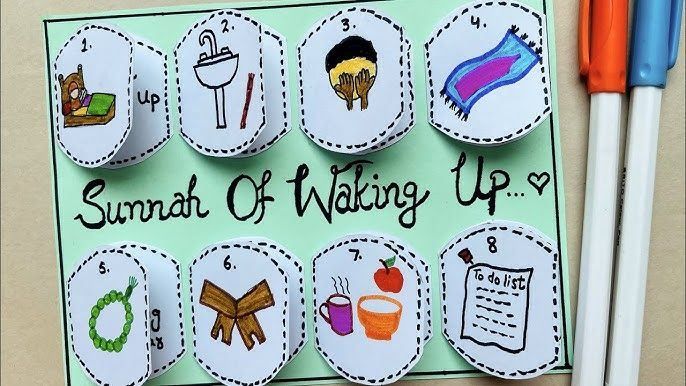
Wake up → Gratitude dua
Bathroom → Brush → Dress
Fajr prayer together
5 minutes Quran
Short dhikr
Breakfast with family
Pack bag
Positive words before leaving
Total time: 45–60 minutes.
It doesn’t need to be complicated.
Most parents are very busy with their own routines, but that’s not to stay that you can’t keep a consistent morning routine going:
Consistency beats complexity.
Morning routines work best when the home environment supports them.
Focus on:
Children copy atmosphere more than instructions.
The Sunnah teaches gentleness. Encourage through:
Avoid shame. Shame disconnects children from faith.
A Sunnah-inspired morning routine is not about producing “perfect” children. It is about raising balanced human beings who begin their day with remembrance, care, and purpose.
Small habits repeated daily become identity.
When children wake with gratitude, pray with family, connect with Quran, care for their bodies, and leave home with positive intention, they carry Islam naturally into the world.
Parents do not need to change everything overnight. Begin with one step — maybe waking dua, maybe Fajr together — and build gradually.
Morning by morning, you are shaping hearts, character, and faith.
And those quiet mornings may become the strongest foundation your child ever receives.
Start simple. Stay consistent. Lead with love.
Published 27 February 2026 in Parenting. Questions? Get in touch.
Learning does not begin and end at school. Some of the most meaningful learning experiences happen in kitchens, living…
Read more →
Modern parenting looks very different from previous generations. In many households, both parents work, schedules are…
Read more →
Every parent, at some point, watches their child interact with others and quietly wonders: Is this normal? Are they…
Read more →Thirty minutes, your student numbers, an honest answer about whether we are a fit. Onboarding, training and data migration are included — there is nothing to sign to find out.