
Every Sidr title carries a Sidr Reading Level from 1 to 10, and every title is assessed against three strands rather than one number. This post explains the model; the reading levels page carries the full ladder and the mapping tables.
Most levelling systems measure decoding, because decoding is the thing that is easy to measure. A child who can decode every word of a book and take nothing from it has still not read it. And a child reading Islamic literature is doing a third thing as well — meeting character, adab and the moral weight of a story.
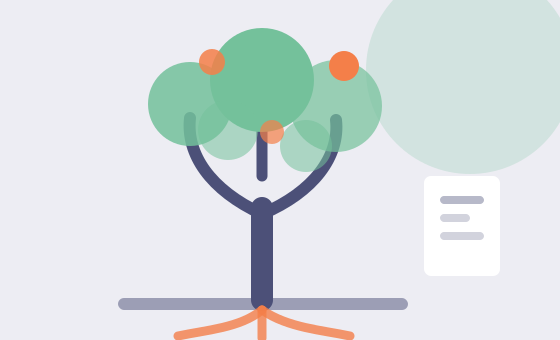
So we assess three strands:
Fruit — skilled, willing, independent reading — is what the three strands grow into. It is deliberately not a fourth thing to assess.
SRL 1–10 is mapped to Oxford Reading Tree stages, UK book-band colours and Lexile ranges, so a school does not have to abandon the scheme it already runs. The mapping is a guide for placement, not an equivalence claim.
The SRL is publisher-developed. It has not been externally validated, it is not a phonics scheme, and it is not a substitute for a teacher’s own assessment of a child in front of them. We say this in the toolkits, on the mapping grids and here, in the same words, because a level that oversells itself is worse than no level at all.
Published 10 July 2026 in Publishing. Questions? Get in touch.

Shortlisted for Best Free Digital Tool for Education — one of eight finalists, with the winner announced in Dubai on 11 November.
Read more →
Noor and her Paper Boat and Yasser’s Dream are on this year’s nomination list — two quiet books about children who keep going.
Read more →
Thirty-six weeks of planning, assessment and home-learning material per series, mapped to four curriculum frameworks — included in the licence, not sold as an add-on.
Read more →Thirty minutes, your student numbers, an honest answer about whether we are a fit. Onboarding, training and data migration are included — there is nothing to sign to find out.