
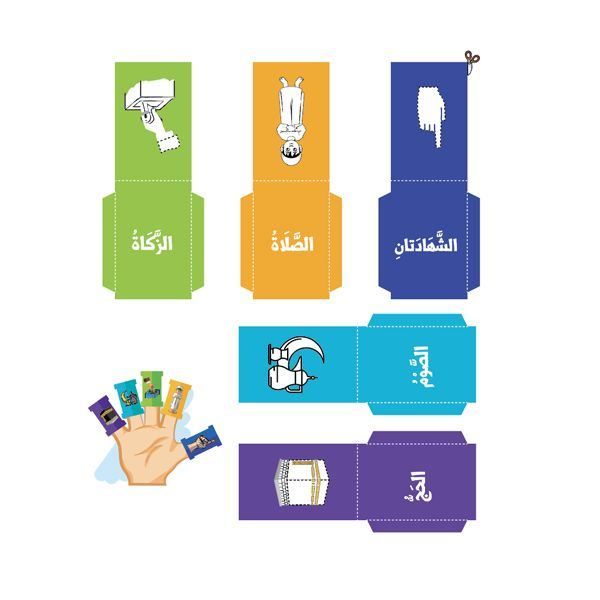
Children love to learn through hands-on activities, there’s no question about it. Whether it’s cutting, pasting, painting, or coloring, craft activities stimulate imagination and deepen understanding through visual and physical interaction. When we discuss how to teach children the Five Pillars of Islam, crafts are not only engaging—they’re also an incredible way to make abstract spiritual concepts tangible for young minds.
In this article, we’ll walk through fun, age-appropriate crafts for each pillar of Islam. These activities are perfect for Islamic schools, homeschooling, Sunday classes, or Ramadan-themed events.
Before we talk about the fun and engaging crafts that help teach children the Five Pillars of Islam, it pays to take in a quick refresher:
Now then, let’s dive into craft ideas that bring each of these pillars to life for children.
Children will create a colorful banner with the Shahadah written in Arabic and English. This helps them memorize and understand the meaning of the testimony of faith.
Materials Needed:
Steps:
Educational Tip:
Explain the meaning of each phrase in the Shahadah and its importance in a Muslim’s identity.
Bonus Idea:
Create a “My Iman Shield” using cardboard and divide it into sections labeled with belief in Allah, His angels, books, and prophets, and the Day of Judgment.
This activity not only engages children creatively but also teaches them about prayer etiquette and the sacredness of salah time.
Materials Needed:
Steps:
Educational Tip:
Use the time to discuss the 5 daily prayers, when they occur, and what we say during Salah.
Bonus Activity:
Make a clock craft to illustrate Salah times using rotating paper dials.
Teach kids the concept of charity by helping them create their own Zakah or Sadaqah collection box to use at home.
Materials Needed:
Steps:
Educational Tip:
Discuss the difference between Zakah (obligatory) and Sadaqah (voluntary) and how both are loved by Allah.
Bonus Craft:
Create “Charity Flowers”—write ways to give (money, time, food) on petals and glue around a paper flower.
Ramadan is a great time to reinforce the concept of Soum (fasting). A daily good-deed calendar helps kids focus not just on not eating—but on gaining rewards and self-control.
Materials Needed:
Steps:
Examples of Deeds:
Educational Tip:
Discuss why we fast—to build taqwa (God-consciousness) and gratitude.
Bonus Idea:
Create a Fasting Chain—every day a child fasts or attempts, they add a paper link to a growing chain.
Take children on a visual pilgrimage through their imaginations by building the major steps of Hajj in a shoebox diorama.
Materials Needed:
Steps:
Educational Tip:
Walk children through the story of Prophet Ibrahim alay salaam and the meaning behind each Hajj ritual.
Bonus Activity:
Create an Ihram Dress-Up Day where kids make ihram from towels and “simulate” the journey around the house.
Want to reineforce the pillars after you teach children the Five Pillars of Islam? Try the following:
| Craft | Pillar | Idea |
| Five Pillars Mobile | All | Hang symbols of each pillar on a string mobile |
| Pillar Puzzle Game | All | DIY puzzle to match pillar name with explanation |
| 3D Pillar Towers | All | Make towers from paper rolls, each labeled with a pillar |
| Fingerprint Deeds Tree | Zakah/Sawm | Kids add a fingerprint leaf for every good deed |
| “Build the Kaaba” Block Craft | Hajj | Use Lego or cardboard cubes to make Kaaba structure |
Crafts don’t just entertain—they also:
When children see, touch, and create, they internalize the values behind the Five Pillars in a way rote memorization can’t achieve.
To teach children the Five Pillars of Islam is to teach them the foundation of our faith. Furthermore, introducing them to the pillars through engaging crafts makes the experience joyful, interactive, and everlasting. Each glue stick, paper cut, and colored marker becomes a tool to build not just crafts—but a child’s understanding of Islam.
By combining faith with creativity, we help children not only learn Islam—but love it.
Published 15 July 2025 in Parenting. Questions? Get in touch.

In today’s fast-paced world, discipline is often misunderstood as punishment. But in Islam, discipline is about…
Read more →
A child’s first school is their home. From the moment they begin to speak and explore the world, the home environment…
Read more →
In today’s fast-paced digital world, where children are drawn to screens, games, and interactive platforms, Islamic…
Read more →Thirty minutes, your student numbers, an honest answer about whether we are a fit. Onboarding, training and data migration are included — there is nothing to sign to find out.