
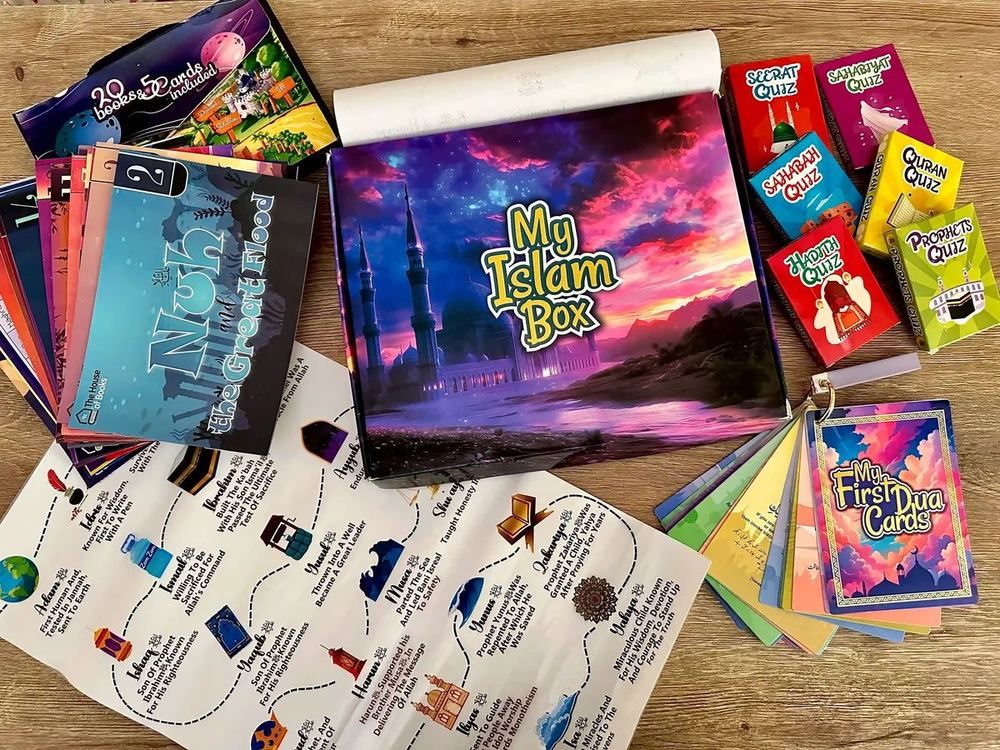
Creating an Islamic children’s book can begin with something very simple: a story you tell your children, an Islamic value you want to explain, a gap you have noticed in existing books or an idea that makes young Muslims excited to learn.
Turning that initial idea into a professionally published children’s book, however, requires much more than writing a story.
Authors need to consider the age of the reader, Islamic accuracy, storytelling, language, illustrations, page design, proofreading, printing and distribution. Every decision influences how children experience the finished book.
This can seem overwhelming for a first-time author, but the process becomes much easier when approached one stage at a time.
Whether you are creating an Islamic picture book, activity book, educational series or story for older children, here is a practical guide to taking your project from initial idea to finished publication.
When we talk about how to create an Islamic children’s book, we should decide why the book needs to exist. And this comes well before writing the first page.
So, think about what children gain from reading it.
Perhaps, you want to introduce an Islamic value such as honesty, gratitude or patience. You may want to help children understand salah, Ramadan or Hajj. Your idea could involve Quran learning, Islamic history or a fictional Muslim character navigating everyday challenges.
Try to define one central purpose, rather than branch off into multiple purposes or story angles.
Children’s books can become confusing when authors attempt to teach too many lessons simultaneously. A strong book usually has one primary idea supported naturally by the story. We believe this is a great starting point.
Having a clear purpose also makes later decisions easier because every character, scene and activity can be evaluated against the same question: does this help communicate the book’s main idea?
“Children” is far too broad an audience.
A book for a four-year-old should be dramatically different from one written for a ten-year-old. Younger readers fare better with simpler vocabulary, shorter sentences, and strong visual storytelling. Illustrations may carry much of the narrative.
As children grow older, stories can become longer and more complex. Characters can face more nuanced challenges, and readers can explore Islamic ideas at greater depth. Defining an age range early helps determine vocabulary, story length, illustration style, page count and even the physical format of the book.
It also prevents one common problem: writing a story that looks like it is for young children but contains language intended for adults.
Accuracy is especially important when creating Islamic educational material.
If your book refers to Quranic accounts, Prophets, Hadith, acts of worship or Islamic history, information should come from reliable sources.
Do not rely simply on stories circulating online.
Where necessary, authors should seek review and scrutiny from someone appropriately qualified in Islamic knowledge, particularly when a book explains religious rulings or presents historical religious accounts.
Arabic text also deserves careful attention. Quranic verses, duas and Arabic terminology should be checked thoroughly for spelling, diacritics and translation accuracy.
A beautifully designed Islamic children’s book can quickly lose credibility if the religious content contains avoidable mistakes.
Once the concept is clear, create the basic structure. Who is the main character? What do they want? What challenge do they encounter? What changes will there be to the story by the end?
Even educational books benefit from narrative progression.
For example, rather than writing several pages explaining why gratitude matters, an author could create a character who initially overlooks everyday blessings and gradually learns to recognise them.
The lesson emerges through experience.
At this stage, concentrate on the sequence rather than perfect wording. A simple outline can prevent the middle of the story from becoming repetitive or disconnected.
Children’s writing may appear simple, but writing simply is difficult.
Authors often have this underlying desire to explain too much as they get caught up in the story. Instead of allowing the character’s behaviour to communicate the lesson in a natural and easily digestible flow, the narrator repeatedly tells readers exactly what they should learn.
Don’t be that author! Instead, trust the story.
So, this means using clear language, natural dialogue and sentences appropriate for the target age. Read the manuscript out aloud because children’s books are frequently shared this way.
If a sentence feels awkward to say, chances are it might also feel awkward to hear.
Reading your story out aloud can reveal issues like repetition, overly long sentences, and dialogue that does not sound natural.
An Islamic children’s book does not need to sound like a lecture to communicate meaningful values.
Often, the strongest approach is to integrate Islamic identity naturally into the characters’ world.
Characters might prepare for salah, use familiar Islamic expressions, visit family during Eid or remember an Islamic teaching when making a decision.
These elements can help Muslim children see aspects of their own lives reflected positively in books. When there is a specific lesson, allow characters to experience it. Children are more likely to remember a value they have seen demonstrated than a paragraph explaining why that value is important.
It can be tempting to begin commissioning illustrations as soon as the first draft is finished, wouldn’t you agree?
But typically, editing should happen first. Here’s why:
Changes to the manuscript after illustration begins can become expensive because removing or adding a scene may require artwork to be changed completely.
Review the story for pacing, age suitability, unnecessary repetition and clarity.
Professional proofreading is also important. Children’s books may contain relatively little text, which means mistakes become particularly noticeable.
If the book contains Arabic and English, both languages should receive appropriate review.
The goal is to make the manuscript as stable as possible before visual production begins.
A storyboard transforms the manuscript into a visual plan.
For each page or spread, decide what text appears and what the illustration needs to communicate. This is where authors often discover pacing problems.
Perhaps, several exciting events have been squeezed onto one page while the following three pages contain very little action. A storyboard allows the book to be rebalanced before detailed illustrations are produced.
It also helps avoid unnecessary duplication. If the text already says that the child walks into a busy market, the illustration can add details about the environment and atmosphere instead of merely repeating the sentence literally.
The strongest children’s books allow words and pictures to work together.
Illustration is one of the most important aspects of children’s publishing.
Characters should remain recognisable throughout the book. Clothing, environments, proportions and colour choices should feel consistent from one spread to another.
The style should also suit the audience. Young children’s books may use simpler shapes and brighter visual storytelling, while older readers may respond to more detailed or sophisticated artwork.
For Islamic books, authors may also have specific visual requirements relating to modesty, historical accuracy or representation. These should be communicated clearly to the illustrator before production begins.
A standardised character sheet and visual style guide can prevent inconsistencies later.
Good book design helps children navigate the story comfortably.
Typography should be easy to read. Text should have enough contrast against illustrations, and important content should not sit dangerously close to trimming or binding areas.
Designers also need to consider visual rhythm. Some spreads may contain large illustrations with very little text, while others may be quieter. This variation can help control pacing.
Arabic-English books require additional planning because the languages have different reading directions and typographic requirements.
Page design should always prioritise readability over decoration.
A beautiful digital file is not automatically ready for professional printing.
Printers require correct page dimensions, bleed, image resolution, colour settings and suitable PDF files.
The binding method also matters.
Board books, paperbacks and hardbacks have different production requirements. Books containing activities may require paper that children can comfortably write on, while picture books may benefit from different finishes.
Always obtain a physical proof where possible. Colours, text sizes and image details can look very different on paper compared with a computer monitor.
A printed proof gives the author an opportunity to identify problems before producing hundreds or thousands of copies.
Authors generally need to choose between working with a traditional publisher and publishing independently. Traditional publishers may manage areas such as editing, design, printing and distribution, although submission processes can be competitive and authors may have less control.
Self-publishing gives authors greater creative control but also places greater responsibility on them. The author may need to coordinate editors, illustrators, designers, printers, online listings and marketing.
Print-on-demand can reduce the need to purchase large quantities of stock, while larger print runs may offer a lower cost per copy when there is sufficient demand.
The best option depends on budget, objectives and intended distribution.
Marketing should not begin on publication day.
Authors can start building awareness while the book is being created.
Behind-the-scenes illustrations, character introductions, educational content and previews can help potential readers discover the project.
Think carefully about who makes the purchasing decision. For younger children’s books, the primary marketing audience is usually parents, teachers, Islamic schools, libraries and gift buyers rather than the child alone.
A professional website or landing page, social media content and relationships with relevant communities can support the launch. Reviews and genuine reader feedback can then strengthen credibility after publication.
If your concept has potential to become a series, consider this during the first project. Consistent character design, typography, cover structure and branding can make future titles immediately recognisable.
A successful Islamic children’s publishing project can also expand into activity books, learning resources, classroom materials or carefully designed digital experiences.
However, the first priority should remain creating one excellent book. We must never lose sight of that when learning and understanding how to create an Islamic children’s book.
A strong first publication provides the foundation for everything that follows.
Many first-time authors make similar mistakes: trying to teach too many lessons, writing language that is too advanced, beginning illustrations before finalising the manuscript or underestimating professional editing and book design.
Another common mistake is focusing almost entirely on the author’s message rather than the child’s experience. Ask throughout the project:
Will a child understand this? Will they remain interested? Does this page move the story forward? Is this appropriate for their age?
Those questions keep your reader at the centre of the creative process.
Any author or publisher serious about learning how to create an Islamic children’s book must understand that creating such content is both a creative and educational responsibility.
The process begins with a clear idea but requires careful development through research, writing, editing, Islamic review, illustration, page design, proofreading, printing and publication.
Each stage matters.
A strong Islamic children’s book should be accurate without becoming overly complicated, educational without feeling like a lecture and visually engaging without allowing design to overwhelm the message.
Most importantly, authors should remember who they are creating the book for.
Children may not care how difficult the publishing process was. They care about whether the story captures their imagination, whether they connect with its characters and whether they want someone to read it again tomorrow.
When thoughtful storytelling, authentic Islamic values and professional design come together, an Islamic children’s book can do much more than teach a lesson.
It can create positive memories around faith, encourage meaningful conversations and become a book that families return to for years.
Published 4 September 2026 in Stories & occasions. Questions? Get in touch.
Stories are more than entertainment—they are tools of education, inspiration, and connection. In the Qur’an itself…
Read more →
Children love stories. They capture the imagination, simplify complex ideas, and provide role models to look up to. The…
Read more →
The moments just before sleep, children are naturally calm, cuddly, and receptive. Neuroscientists call this the…
Read more →Thirty minutes, your student numbers, an honest answer about whether we are a fit. Onboarding, training and data migration are included — there is nothing to sign to find out.